
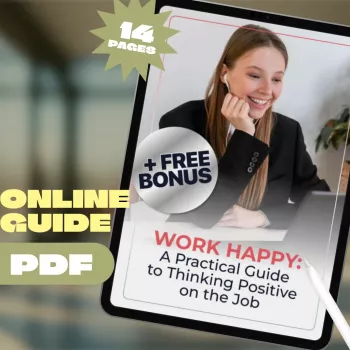
Positive thinking isn’t about ignoring challenges; it’s about training attention, language, and habits so everyday decisions feel lighter and more intentional. Read Happy: Unlocking the Power of Positive Thinking Books (digital guide) is designed to turn self-help reading into practical mindset growth—helping readers build a more optimistic inner voice, recover faster from setbacks, and create simple routines that support personal development.
Positive thinking works best when it’s treated like a skill. Instead of waiting to “feel positive,” it focuses on noticing automatic thoughts, questioning unhelpful assumptions, and choosing more helpful interpretations that fit the facts.
It also helps to clear up what positivity isn’t. It’s not denial, forced happiness, or pretending everything is fine. Real optimism can acknowledge stress and disappointment while still asking, “What’s the next controllable step?” The Mayo Clinic notes that shifting negative self-talk can reduce stress and support coping over time (Mayo Clinic).
Language matters here. The words used internally (“I’m failing” vs. “This is hard, and I’m learning”) influence emotion, motivation, and follow-through. Tiny wording changes often produce surprisingly tangible changes in behavior—especially when repeated daily.
This guide is a good match for readers who like personal development books, but want clearer takeaways that translate into action the same day. It also fits busy learners who prefer short, structured sessions instead of long reading marathons.
When stress is high, the brain’s threat system can stay activated, which can make setbacks feel larger than they are. The American Psychological Association explains how stress affects the body and can influence mood, sleep, and energy (APA). A structured “read-and-apply” approach helps by narrowing focus to one doable change at a time.
Many people experience a “negativity bias”—the mind’s tendency to spotlight threats and overlook neutral or positive evidence. A practical reading habit trains attention to include what’s working, not as a pep talk, but as a more accurate picture.
Reframing shifts statements like “I’m bad at this” into “I’m practicing this.” The goal isn’t sugarcoating; it’s replacing stuck language with language that leaves room for improvement.
Harsh inner criticism can feel motivating in the moment, but it often increases avoidance later. Self-compassion uses constructive, coach-like language: honest about the issue, respectful about the person.
Instead of “I’m grateful for my life,” try “I’m grateful my friend checked in today” or “I’m grateful I had 20 quiet minutes this morning.” Specific gratitude tends to feel real—and the NIH highlights links between gratitude practices and well-being (NIH).
Mindset growth sticks when it becomes identity-aligned: “I’m someone who follows through in small ways.” It’s less about perfect outcomes and more about repeatable proof.
The fastest way to turn inspiring pages into real change is to shrink the plan. Keep the reading small and the action even smaller.
| Day | Reading focus | 1 practical action | Quick reflection prompt |
|---|---|---|---|
| 1 | Awareness of self-talk | Catch one negative thought and rewrite it in a helpful, realistic way | What changed when the wording changed? |
| 2 | Reframing setbacks | Turn one mistake into a lesson statement | What did the situation teach? |
| 3 | Gratitude that feels real | List 3 specific details you appreciate today | Which detail shifted mood the most? |
| 4 | Confidence through evidence | Write 2 examples of past follow-through | What strengths showed up? |
| 5 | Boundaries and energy | Say no (or “not today”) to one low-value task | How did your time/energy respond? |
| 6 | Optimistic planning | Pick one meaningful task and define the smallest next step | What made it easier to start? |
| 7 | Integration | Choose your top 2 practices to repeat next week | What will keep this sustainable? |
No. Constructive optimism acknowledges reality, names the challenge clearly, and then focuses attention on what’s controllable and what helpful interpretation supports the next step.
Many people notice small shifts in days, with more reliable change over a few weeks. Consistency matters more than session length, so track one small behavior change to see progress clearly.
Use a read-and-apply routine: one takeaway, one action, one reflection. Start tiny, repeat the same practice for several days, and let repetition turn insight into automatic behavior.












Leave a comment