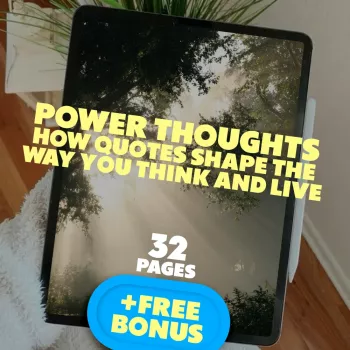
Quotes can act like mental “shortcuts”—a few words that prime attention, shape interpretation, and influence what happens next. The difference between a quote that helps and a quote that harms usually isn’t the author’s fame; it’s whether the line increases your sense of choice in the moment and nudges you toward a better next step. Below is a practical way to use positive and negative thinking quotes as a repeatable mindset practice—especially with the Power Thoughts digital download.
A quote can shift your day because words shape what your brain highlights. In psychology, this is closely related to “priming”—when an earlier cue influences what you notice and how you respond next (see the APA definition of priming). If you start the morning with language about patience, you may spot opportunities to slow down; if you start with language about threat, you may spot reasons to brace for impact.
Quotes also work because short phrases are easy to rehearse. A long essay might inspire you once, but a single line can become an internal script you hear during stress, conflict, or fatigue. The real power is meaning: the right words can reframe a problem as a challenge, a lesson, or a choice. For best results, pair a quote with a small action—one email, one walk, one boundary—so the quote becomes a cue for behavior, not a decoration.
Positive quotes tend to support persistence, self-compassion, and long-term focus when they feel believable and specific. A grounded line like “Do the next right thing” often lands better than a sweeping promise that everything will be perfect. Negative or cynical quotes can occasionally provide clarity—naming reality, calling out excuses—but repeated uncritically, they can train hopelessness and reinforce a negative identity.
Context changes everything. The exact same quote can land differently during burnout, grief, pressure, or conflict. A useful filter is agency: if a quote increases agency (choices, next steps), it tends to help; if it removes agency (fatalism, self-blame), it tends to harm. This lines up well with the way CBT encourages examining thoughts for usefulness and accuracy rather than treating every thought as a fact (overview from the NHS on CBT).
| Type of quote | Common effect | Best use | Watch out for |
|---|---|---|---|
| Grounded positive (realistic encouragement) | Boosts effort and calm | Planning, learning, recovery | Empty optimism that ignores constraints |
| Compassionate (self-kindness under stress) | Reduces shame and rumination | Mistakes, setbacks, anxiety | Using kindness to avoid accountability |
| Challenging (tough love / discipline) | Increases urgency and focus | Procrastination, training, deadlines | Harshness that becomes self-attack |
| Cynical or defeatist | Narrows attention; lowers hope | Rarely useful beyond humor or venting | Reinforcing helplessness and negative identity |
Repeated lines quietly become identity statements—“I am the kind of person who…”—even when the words don’t explicitly say it. This is why a quote you repeat daily matters more than one you like once. Over time, self-talk influences emotional regulation: kinder internal language often supports steadier responses under pressure, while harsh internal language can make stress feel personal and permanent.
Quotes also create default interpretations. With one repeated script, setbacks become proof of failure; with a different script, setbacks become proof of learning. If you want something that holds up in real life, choose quotes that describe behaviors (showing up, practicing, asking for help) rather than fixed traits (smart, lucky, broken). Narratives can shape belief so strongly that people can defend them even when evidence shifts, a theme explored in work on self-deception and motivated interpretation (see the Stanford Encyclopedia of Philosophy entry on self-deception).
Power Thoughts: How Quotes Shape the Way You Think and Live is built for practical use: read a page, choose a line, and apply it immediately to a real situation. It includes both positive and negative thinking examples so it’s easier to recognize the difference between a helpful reframe and a harmful mental loop.
It also fits neatly into routines—journaling, morning resets, or a weekly “swap the script” review—so the quotes don’t stay abstract. If you like pairing motivation with structure, the Young Leader’s Power Checklist can add a concrete next-step mindset for school, work, and leadership habits. And if your mindset struggles are sleep-related, the Better Sleep During Pregnancy guide supports a calmer baseline so your “power thoughts” have more room to stick.
They work best when they’re believable, repeated, and paired with a small action. Grounded encouragement can steady attention and behavior, while empty optimism often fades because it doesn’t connect to real constraints.
Some challenging “reality check” lines can prompt accountability and help you stop making excuses. But repeated cynicism tends to reduce agency over time, so it’s safest to keep only what points to a next step.
Using one quote for a week (or 7–14 days) gives repetition enough time to influence daily choices. Track whether it improves your actions and mood, then keep it or swap it based on results.










Leave a comment