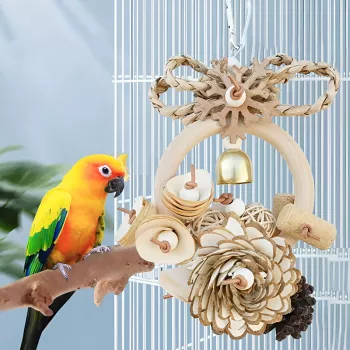
Chewing and shredding aren’t “extra” activities for parrots—they’re daily behaviors that help keep beaks busy, bodies active, and minds occupied. A ring-style toy made from natural wood and plant fibers offers straightforward enrichment: something to gnaw, pull apart, and investigate from different angles. Below is a practical guide to what a natural chew ring adds to a cage, how to set it up safely, and simple ways to keep it interesting over time. For more guidance, see 🌱🦜 Support healthy beak care with this natural wood chew ….
Most companion parrots are hardwired to work with their beaks. When a bird doesn’t have appropriate items to chew, that energy can shift toward bars, food bowls, or household objects. Offering a dedicated chew toy helps channel that instinct into a safer, more satisfying routine. For further reading, see Something for every beak! These hanging bird toys are ….
For broader bird-care guidance and environmental needs, resources like the AVMA companion bird care page and the Association of Avian Veterinarians (AAV) are helpful starting points.
A ring toy is simple, but the shape and texture mix can make it surprisingly engaging. Unlike a single block or straight perch toy, a ring gives multiple “approach points,” which can matter for birds that like to grip and manipulate while they chew.
Not all “natural” toys are built the same. Focus on how the components behave under beak pressure: you want chewable and shred-friendly, not sharp, brittle, or chemically treated.
Even well-made bird toys should be inspected regularly. Parrots are persistent problem-solvers, and a toy that’s safe on day one can change after enthusiastic chewing.
| What to check | What “good” looks like | When to replace |
|---|---|---|
| Wood condition | Smooth, chewable surfaces; no deep cracks | Splintering, deep splits, or jagged points |
| Plant fiber strands | Short, fray-able fibers that break away easily | Long stringy loops forming repeatedly |
| Hanging connection | Tight, secure attachment; minimal sharp metal exposure | Loose hardware, rust, or exposed sharp ends |
| Toy placement | Bird can chew without stretching or slipping | Toy causes awkward reach or interferes with perches |
For general household hazard awareness (especially important if your bird has out-of-cage time), the ASPCA’s household hazards guidance is a useful reference.
Size selection is less about “one toy fits all” and more about matching weight, toughness, and how much space your bird has to play. A chew ring should be easy to reach and satisfying to work on—without dominating the cage or breaking apart too aggressively.
If you’re looking for a simple, daily-use chew toy, the Natural Wood & Plant Chew Ring Toy for Parrots is designed as a hanging ring-style option for steady gnawing and shredding enrichment. The natural texture mix encourages exploratory beak work and foot coordination, and it’s easy to position as a dedicated “chew station” near a favorite perch.
For a dedicated bathing option, consider the Hanging Bird Bath Box as an easy add-on to your bird’s cage routine.
It can be safe when it’s made from untreated, bird-safe materials and checked often. Avoid toys with strong chemical odors or coatings, inspect for sharp edges, and remove or replace the toy if fibers become long and stringy or if wood starts splintering.
It depends on your bird’s size and chewing style—some birds lightly shred for weeks, while heavy chewers can break down a toy quickly. Replace when you see splinters, loose connections, repeated long loops of fiber, or heavy soiling, and rotate toys to keep interest up.
Hang it near a favored perch so your bird can reach it comfortably without stretching, slipping, or blocking access to food and water. For a cautious bird, start slightly below perch height and supervise early sessions so you can adjust placement if needed.










Leave a comment