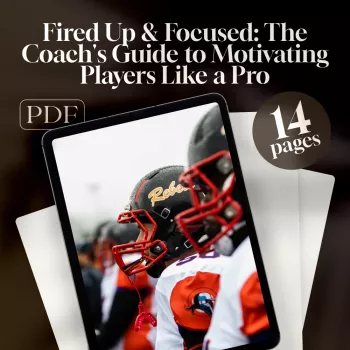
Motivation isn’t a speech—it’s a repeatable system players can feel in practice, in the locker room, and in the huddle. Fired Up & Focused is built for coaches who want more energy, better attention, and stronger team standards without nagging, guessing, or waiting for “game-day intensity” to magically show up.
When motivation is working, you don’t have to hunt for it—you see it, hear it, and track it across the week.
This lines up with how motivation is commonly defined as the forces that initiate and sustain goal-directed behavior (see the APA Dictionary of Psychology), but the coaching win is making it visible and repeatable.
Players usually don’t “stop caring” out of nowhere. Most tune-out happens when the environment feels confusing, impossible, or unrewarding.
When your standards are clear and your feedback protects confidence, you’ll often see players re-engage fast—especially when you add autonomy-supportive language and ownership opportunities (a core idea in Self-Determination Theory).
Our team built Fired Up & Focused around a simple loop you can run every practice—without changing your personality or turning into a motivational speaker.
This is how motivation becomes something your players experience all week, not something they “try to feel” right before kickoff.
Tools only work when they save time, reduce arguing, and give everyone a shared language. That’s why the printables in Fired Up & Focused: The Coach’s Guide to Motivating Players Like a Pro (Digital Coaching Guide + Printable Locker Room Tools) are built to be short, direct, and easy to reuse.
| Moment | Goal | Tool to use | Keep it to |
|---|---|---|---|
| Before practice | Create a shared focus | Focus prompt + one standard for the day | 30–60 seconds |
| During high-intensity drills | Maintain energy and attention | Challenge target + effort/communication cue | One sentence |
| After mistakes | Stop the emotional slide | Reset script + immediate re-rep | 10–20 seconds |
| End of practice | Lock in learning | One reflection question + one commitment | 2 minutes |
| Game day / post-game | Steady confidence and accountability | Pre-game cue + post-game reset prompt | 3–5 minutes |
You don’t need five personalities to coach five personalities. You need one system, then small adjustments in what you emphasize.
If you want a simple way to build leadership behaviors alongside motivation routines, pair your weekly standards with Your Ultimate Young Leader’s Power Checklist so you can hand players clear leadership actions to own.
This is also where positive culture habits matter—especially consistency in standards and language (see the Positive Coaching Alliance for culture-building principles you can reinforce with your daily routines).
Use a repeatable routine: set one clear daily standard, give a short challenge target for each segment, name the behaviors you want when you see them, then correct with a quick reset and an immediate chance to try again. End practice with one reflection prompt so motivation comes from structure instead of volume.
They help when you attach them to specific moments (pre-practice, after mistakes, post-game) and keep them short. Players follow what you consistently reference, so the key is using the same language every day—not adding more posters.
It works well from youth through high school and beyond because it’s built on clear expectations, simple accountability, and athlete-friendly routines. You can scale the wording and challenge targets to match your level and time limits.











Leave a comment