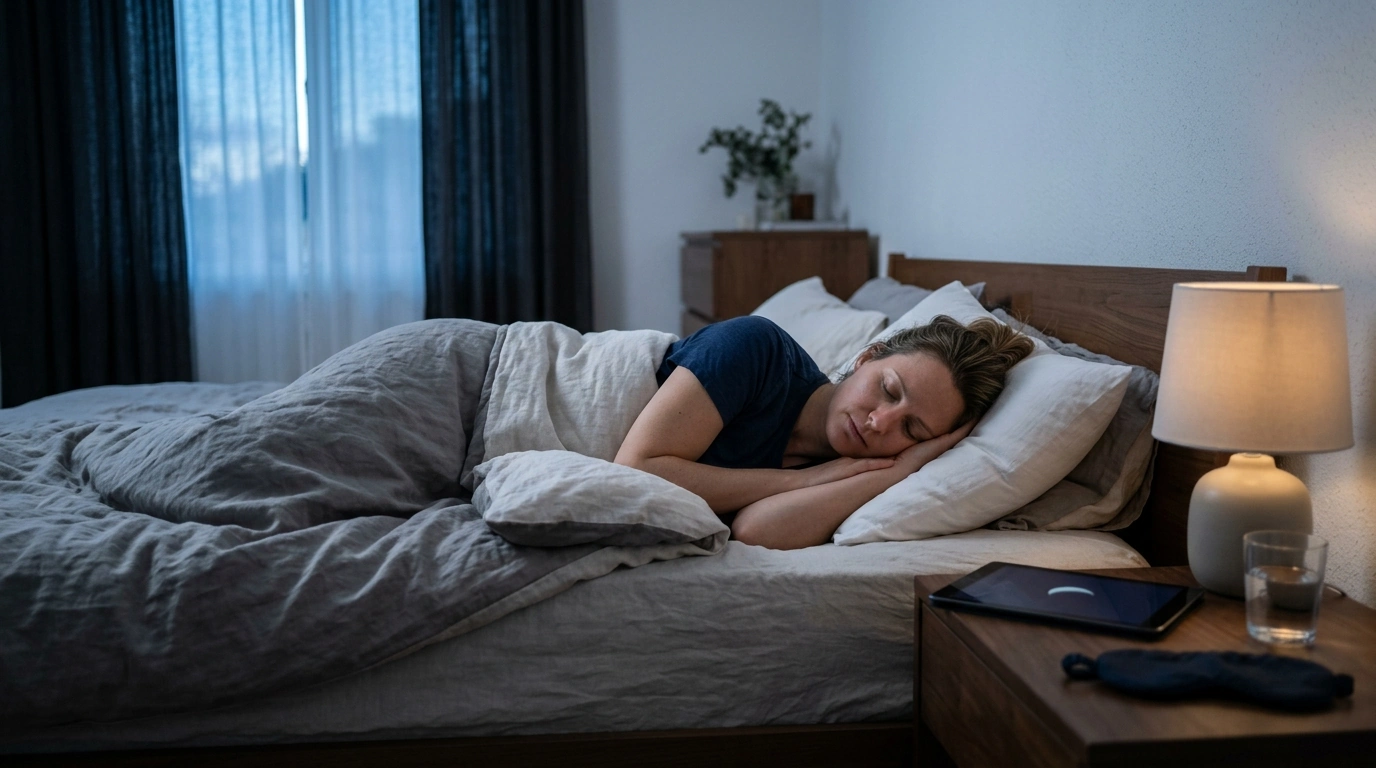
Deep sleep is the stage most closely tied to physical recovery, immune function, and feeling restored the next day. The goal isn’t chasing a perfect number every night, but understanding what “enough” looks like for age and lifestyle—and building habits that make deep sleep more likely. If you’ve ever slept “a full night” yet still felt foggy, sore, or unusually snacky the next day, the missing piece is often sleep quality and continuity—not just hours in bed.
Deep sleep is also called slow-wave sleep (N3). It’s a non-REM stage associated with physical restoration—tissue repair, immune support, and replenishing energy. Many people describe waking from deep sleep as feeling “heavy” or disoriented for a few minutes (sleep inertia), because the brain is in a slower, more synchronized rhythm.
Deep sleep tends to appear more in the first half of the night. That timing matters: if bedtime drifts later, or sleep is repeatedly interrupted early, you can lose a disproportionate share of deep sleep even when your total sleep time looks decent on paper.
Dreaming can happen in multiple stages, but vivid, story-like dreams are more common in REM. Deep sleep is typically dream-light and harder to wake from, which is one reason it’s linked to that “knocked out” feeling when sleep is truly restorative.
For most adults, deep sleep is best thought of as a proportion of the night rather than a fixed hourly target. Many healthy adults land around 13–23% of total sleep time, with normal night-to-night swings. On an 8-hour night, that often translates to roughly 1–2 hours of deep sleep.
Age is a major factor. Deep sleep generally declines across adulthood, so comparing your numbers to teen or college-age benchmarks can be misleading and unnecessarily stressful. A more useful benchmark is how you function in the morning and afternoon: steady energy, fewer cravings, more stable mood, and less “body soreness” can be signs you’re getting enough restorative sleep—even if your tracker doesn’t show a perfect score every night.
| Total sleep time | Approx. deep sleep range (13–23%) | Notes |
|---|---|---|
| 6 hours | 47–83 minutes | Short nights often reduce deep sleep opportunity |
| 7 hours | 55–97 minutes | A common range for many working adults |
| 8 hours | 62–110 minutes | Often aligns with feeling fully restored |
| 9 hours | 70–124 minutes | More time can help if sleep was previously restricted |
Consumer wearables estimate sleep stages using movement and heart-rate patterns. That can be directionally helpful, but it isn’t the same as clinical sleep staging measured in a lab. A single low “deep sleep” night on a tracker isn’t automatically a problem—especially if you feel fine the next day.
| Change | Why it helps | Simple starting point |
|---|---|---|
| Fixed wake time | Stabilizes circadian rhythm | Keep wake time within a 30–60 minute window daily |
| Cooler room | Supports temperature drop needed for deeper sleep | Aim for a comfortably cool bedroom; adjust bedding first |
| Earlier caffeine cutoff | Reduces sleep fragmentation | Move last caffeine earlier by 1–2 hours per week |
| Earlier alcohol cutoff | Less rebound wakefulness later at night | Avoid within 3–4 hours of bedtime |
| Wind-down routine | Lowers physiological arousal | Choose 2 steps: dim lights + relaxing reading/stretching |
If fatigue persists despite adequate sleep opportunity, a clinician can help evaluate root causes and treatment options that may improve sleep quality. For foundational sleep education, the American Academy of Sleep Medicine, the CDC, and the NHLBI provide reliable overviews of sleep stages and sleep health.
If you prefer a clear checklist and troubleshooting flow, Deep Sleep Decoded: How Much You Really Need (and How to Get It) (Digital Download) turns the essentials into a repeatable routine—especially helpful when you feel stuck in “tired but wired,” your schedule is inconsistent, or your tracker data is all over the place.
For moms-to-be dealing with shifting sleep needs, A Real-Life Guide to Better Sleep During Pregnancy (Digital Download) offers practical adjustments that fit common pregnancy-related sleep challenges.
For many adults, deep sleep typically falls around 13–23% of total sleep time, so 30 minutes is often low unless the total night was very short. One low night can happen, but repeated very low values plus fatigue can point to fragmentation, short sleep duration, alcohol/caffeine timing, stress, or a sleep issue worth evaluating.
After sleep restriction, the body can increase deep sleep pressure during recovery sleep, so you may see a rebound when you extend sleep opportunity. Consistency still matters most: stabilizing wake time and avoiding frequent late nights helps deep sleep return more reliably than sporadic catch-up weekends.
Trackers estimate stages and can misclassify light sleep and brief wake periods, especially if sleep is fragmented. A longer night can include more awake time or lighter sleep (from heat, stress, or late alcohol), so the “deep sleep” estimate may drop even though time in bed increased.











Leave a comment