
Confidence can swing a possession, a practice, or a whole season. A steady supply of the right words—short, memorable, and repeatable—helps athletes and coaches lock in on effort, discipline, teamwork, and composure under pressure. This guide shares practical ways to use motivational basketball quotes in warm-ups, workouts, film sessions, and game-day routines, plus a digital eBook built to keep that mindset within reach.
Basketball moves fast, and so does momentum. The best quotes work like a mental “tap on the shoulder”—quick enough to use in real time and strong enough to redirect attention.
That “controllables” approach aligns with how performance psychology emphasizes routines, self-talk, and focus skills for competitive environments (see American Psychological Association — sport, exercise, and performance psychology).
Not every line belongs in every moment. The most useful motivational basketball quotes match a specific habit you’re trying to repeat under pressure.
If an athlete is dealing with stress, anxiety, or burnout, pairing motivational language with healthy support matters too. The NCAA mental health resources hub is a strong starting point for understanding support options and warning signs.
Quotes land best when they’re attached to a routine. Treat them like coaching points that fit in a single breath.
| Moment | Best quote style | Behavior to reinforce | Example cue (short) |
|---|---|---|---|
| Pre-practice | Focus + effort | Sprint to spots, loud communication | “Win the warm-up.” |
| Shooting drills | Confidence + routine | Same footwork every rep | “Trust the work.” |
| Defensive shell | Toughness + teamwork | Gap help, talk early, recover | “Five move as one.” |
| Late-game scrimmage | Composure + next play | No arguing calls, quick huddles | “Next possession.” |
| Post-game | Growth mindset | Film review and specific goals | “Learn fast.” |
On game day, the goal isn’t hype—it’s clarity. The best quotes become a switch you can flip when legs get heavy and the crowd gets loud.
A simple approach is to assign each quote a job: one line for your feet (pace), one line for your eyes (reads), and one line for your voice (communication). When your brain tries to race ahead, the cue brings you back to the possession you’re in.
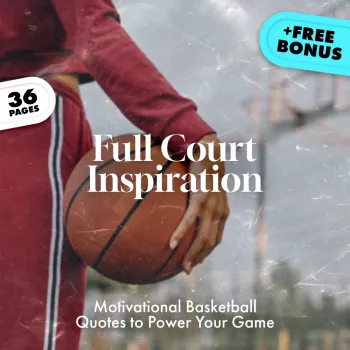
For athletes and coaches who want motivation that’s actually usable in real basketball moments, Full Court Inspiration: Motivational Basketball Quotes to Power Your Game (digital download) is built for quick reference—before practice, during travel, or when a player needs a reset without a long speech.
For captains who want an extra structure for leading without lecturing, pairing the mindset work with a simple leadership tool can help: Your Ultimate Young Leader’s Power Checklist (digital download).
Keep quotes brief and attach each one to a single behavior, like talking on defense, boxing out, or sprinting back. Use them at consistent moments—warm-up, first huddle, or the final two minutes—so players expect the cue and immediately act on it.
Yes, when the quote functions as a performance cue that resets attention on controllables like footwork, shot routine, and effort plays. Pair it with a simple plan—extra reps, targeted film review, and one measurable goal—so it becomes action, not just hype.
A strong pre-game quote is short enough to repeat, focused on effort and decisions, and combines confidence with composure and team-first language. Avoid outcome-only lines and choose something that guides the first few possessions.












Leave a comment